
The Accountability Structure: Why Every Artist Needs a Wall to Run Into

We have been taught to think of procrastination as a moral failing, the “Thief of Time,” the enemy of the serious artist, the character flaw that separates the merely talented from the truly disciplined. Psychology textbooks call it a “self-regulation failure.” Productivity culture calls it a disease to be cured, a symptom of low conscientiousness that spirals into anxiety, lower performance, and regret.
And yet, when you look honestly at the biographical record of the artists we most revere, the ones whose work genuinely changed how we see, you find, again and again, the same stubborn pattern: they were spectacular at putting things off. Not all the time, and not without consequence. But the delay was rarely accidental. It was doing something.
New research is beginning to name what artists have practiced intuitively for centuries. Studies ranging from business problem-solving experiments in the United States to workplace field studies in Korea have uncovered what scientists call a curvilinear relationship between procrastination and creativity, an inverted-U-shaped curve in which moderate procrastinators1 consistently generate more original ideas than those who either dive in immediately or wait until the very last second. The goal, the data suggests, is not to eliminate the stall. It is to master it.
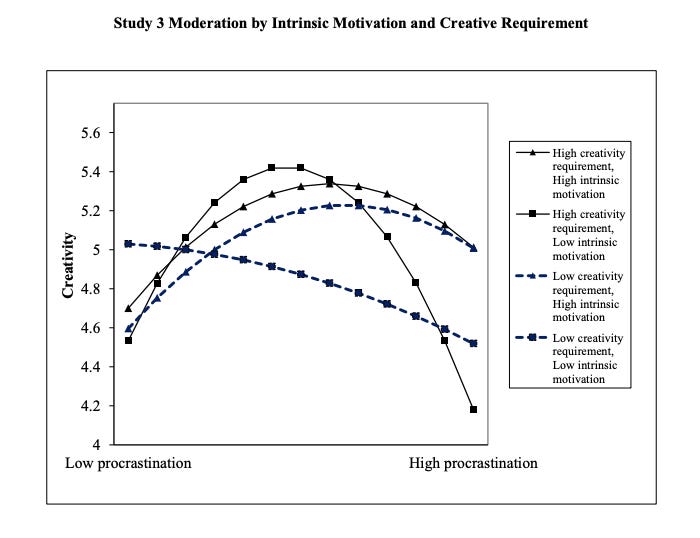
But here is the part that never makes it into the productivity articles: mastering the stall requires something that looks nothing like stalling. It requires accountability, the external structure that transforms a formless delay into productive incubation and stops creative wandering from becoming permanent disappearance.
Accountability, in this reading, is not the enemy of procrastination. It is its essential partner. The wall the stall needs to run into.
Aha! Moment
To understand why moderate procrastination helps, you first have to understand what happens inside the creative mind when it steps away from a problem it cannot immediately solve. Researchers call it the forgetting fixation effect2. When you sit down to begin a creative task and immediately start working, your mind tends to lock onto the most obvious, conventional interpretation of the problem, the first idea, the safe idea, the one that arrives before genuine thinking has had time to occur. This is fixation: the cognitive equivalent of a groove worn into a record. The more urgently you push toward a solution, the deeper the groove gets.
When you step away, when you go for a walk, spiral into a documentary about birds, or spend an hour with something apparently unrelated to the work, the fixation begins to dissolve. Three distinct mental shifts occur during this period of moderate delay. The first is problem restructuring: your mind has space to reconsider the creative challenge from new angles, rather than being trapped by its first, most conventional framing. The second is incubation and mind wandering: while engaged in something “mindless,” your subconscious continues working on the task in the background, quietly hatching a solution your conscious effort could not have reached. The third is the activation of new knowledge: the diverse information encountered during the delay, the bird documentary, the overheard conversation, the article you read instead of painting, gets synthesized into the work, making the eventual output more original than anything you could have produced by simply starting immediately.
The most spontaneous creative bursts are preceded by invisible incubation. The brain needs unstructured time, boredom, wandering, and hesitation to connect the fragments that logic cannot.
This is a measurable cognitive process. But the science also contains a warning that rarely accompanies the good news: procrastination produces more creative outcomes at a literal cost of lower task efficiency. The moderate stall delivers more original work, but it also compresses the execution phase. Intrinsic motivation is also a non-negotiable: the delay only “pays off” when you genuinely care about the work. If the project doesn’t move you, the stall is simply a stall. And without a boundary, without the accountability structure that says “Thursday is the critique”, the circling never resolves.
Leonardo and the Patient Duke
In 1490, Leonardo was commissioned to paint The Last Supper on the refectory wall of Santa Maria delle Grazie. The prior of the monastery, growing increasingly agitated by Leonardo’s erratic presence, some days seizing the brush before sunrise and working until he forgot to eat, other days arriving to stare at the plaster for hours without making a single mark, then abruptly leaving, complained to the Duke of Milan. The Duke summoned Leonardo to explain himself.
Leonardo da Vinci — The Last Supper, c. 1495–1498
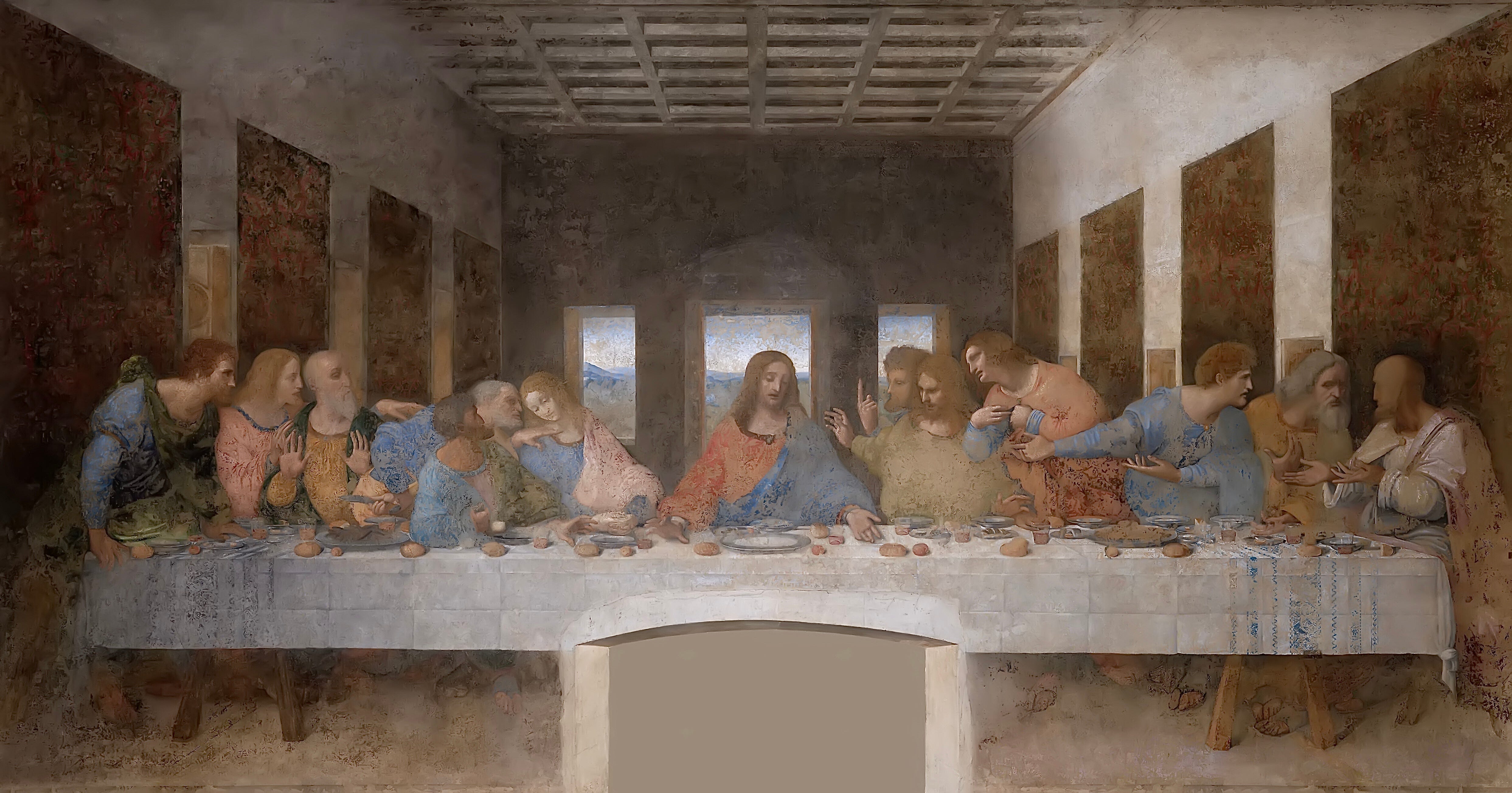
Leonardo explained to the Duke that men of lofty genius sometimes accomplish the most when they appear to work least, for their minds are occupied with their ideas and the perfection of their conceptions, to which they afterward give form. The hours of apparent idleness were not lost hours. They were the hours in which the painting was being built, mentally, with a precision the brush would later execute. As for Judas, he was still searching for the right face. And if the prior continued pressing him, he might simply use the prior’s own face as the model. The Duke, according to Vasari, found this very funny.
Leonardo’s stalling on The Last Supper3 was genuinely productive; the painting is considered one of the supreme achievements in Western art, and the psychological complexity of its composition suggests those hours of apparent idleness were doing precisely the work that conscious effort could not. But Leonardo’s relationship with procrastination throughout his career tells another story. He began the Adoration of the Magi in 1480 and left for Milan, never finishing it. The Virgin on the Rocks, commissioned with a seven-month deadline, took twenty-five years. The Mona Lisa occupied him for roughly fifteen years and was reportedly still being tinkered with when he died. As Giorgio Vasari4 observed: “Leonardo started so many things without finishing them.” On his deathbed, Leonardo lamented that he had “offended God and humanity in not having worked at his art as he should have.”
There are only 15 finished paintings attributed to Leonardo da Vinci across roughly forty years of active practice, a man whose notebooks contained thousands of ideas, inventions, and anatomical studies that were never realized in his lifetime.
In comparison, Van Gogh produced 2,100+ works in a single decade of focused, accountable practice.
The lesson of Leonardo is not that procrastination is fatal to creative achievement; the works he did complete are among the most studied in human history. The lesson is that without a structure that converts the productive stall into completed work, even genius becomes its own trap.
The Deliberate Wait: Hilma af Klint
Between 1906 and 1915, Hilma af Klint produced a series of 193 large-scale abstract paintings she called The Paintings for the Temple, works of startling originality that predated the abstract paintings of Kandinsky, Mondrian, and Malevich, figures who would later be credited with inventing abstraction itself. Af Klint knew exactly what she had made. She also knew, with a clarity that reads as either visionary or heartbreaking depending on your angle, that the world was not yet ready to receive it.5
Hilma af Klint — Paintings for the Temple, 1906–1915
“When af Klint died in 1944, she stipulated that the paintings should not be shown publicly for at least twenty years after her death. She believed the audience capable of understanding the work did not yet exist. It took more than sixty years, and a landmark Guggenheim exhibition6 in 2018–19, which drew more visitors than any previous show in the museum’s history, for the world to catch up. ‘She did not wait for the world to discover her paintings,’ wrote critic Prudence Peiffer. ‘The world had to wait for them.’”
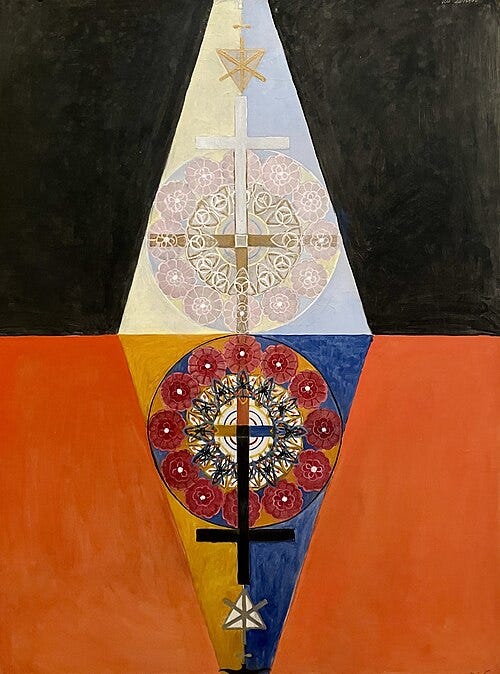
Af Klint’s delay was not avoidance. She was extraordinarily productive, completing over a thousand paintings and works on paper across her lifetime. The stall can be considered strategic: a considered judgment about timing, audience, and the conditions under which genuinely original work can be received rather than dismissed. This is the most sophisticated form of productive procrastination, not the delay of inaction, but the delay of readiness7.
What made this possible, what kept the deliberate wait from curdling into self-doubt or paralysis, was that af Klint worked within a small, tight accountability structure she called “The Five”: a circle of women artists and thinkers who met regularly, shared their work, and held each other to a standard that was simultaneously rigorous and patient. The group did not ask, “When will you show this?” They asked: “Is this true?” The accountability was to quality and vision, not to the external market’s timeline. The stall was protected by the group. The group made the stall sustainable.
Controlled Accident: Gerhard Richter
Gerhard Richter has spent sixty years developing a body of work that is, at its structural core, a formalized practice of productive procrastination, not delay as inaction, but delay as a rigorous act of withholding judgment, and then, occasionally, a bonfire.
After arriving in West Germany in the early 1960s, Richter spent a year painting furiously, moving from figuration to abstraction. Then, without telling anyone, he carried the entire year’s output into the academy courtyard and burned it. He has destroyed large portions of his work at multiple points in his career. At other times, he overpainted, a technique he calls Vermalung8, in which a completed image is partially obliterated by subsequent gestural marks, leaving it suspended between what it was and what it is becoming.
Gerhard Richter — Vermalung9 & the Squeegee Paintings, 1960s–present
“Richter’s abstract squeegee paintings are built on what he calls ‘controlled accident.’ He applies thick layers of paint, then drags a wide squeegee across the wet surface, a tool that catches multiple layers simultaneously, creating passages of chromatic depth that no deliberate brushstroke could produce. He sets the parameters. Then he waits to see what the paint does. The delay, the surrender of direct control, is not a flaw in the method. It is the method. ‘Sometimes, when I see one of the photos, I think: that’s too bad; you could have let this one survive,’ he told Der Spiegel.”
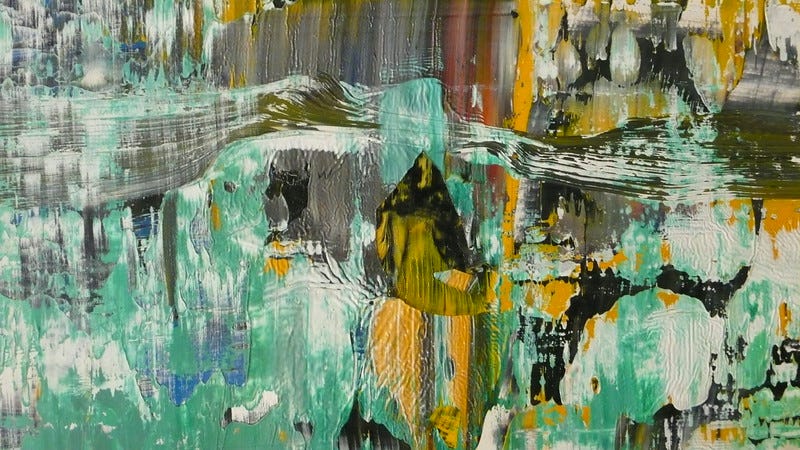
What is remarkable about Richter’s practice10, viewed through the lens of productive procrastination, is how thoroughly the stall has been institutionalized. The delay is engineered into the physical act of making. He applies paint. He waits. Time does something to the surface that his will cannot. Beyond the method, Richter has maintained a meticulous catalog of every piece since 1962, numbered, documented, and assigned its place in the ongoing project of a sixty-year practice. This is accountability as institutional self-governance. The catalog makes every decision, to complete, to destroy, to withhold, a deliberate act that is recorded and owned. Richter has, in effect, solved the Leonardo problem: he found a way to make the stall structural and the accountability personal.
Reclaiming the Time Waster
In the language of organizational psychology, workers are sorted into three archetypes: the turtles, slow, steady, methodical, they finish consistently if not brilliantly; the task ninjas, pre-crastinators who begin early and submit first, efficient but prone to foreclosing the incubation that originality requires; and the time wasters, procrastinators who delay, scramble, and frequently produce the most interesting work.
For artists, the “time waster” label has always felt like a misfiled diagnosis. The research is beginning to agree. The curvilinear finding, that moderate procrastinators outperform both early starters and last-minute rushers on creative originality, suggests that the artist who spends three days circling a problem before touching it is not wasting time. She is doing the part of the work that cannot be done at the desk. But without a boundary, without the accountability structure that says “Thursday is the critique and your work will be seen,” the circling never resolves. The stall becomes a permanent condition. And the work that was supposed to be a masterpiece remains, like Leonardo’s Adoration, a permanently unfinished thing.
Dr. Gail Matthews at Dominican University of California demonstrated that you are 42% more likely to achieve your goals simply by writing them down. Her study of 267 participants found that combining written goals with action plans, accountability, and regular progress updates significantly increases success rates. Sending weekly progress updates to a friend led to over 70% of participants reporting successful goal achievement (either accomplished or more than halfway).
Mastering the Moderate Stall
What separates the productive stall from its destructive counterpart is not willpower in the conventional sense. It is two things held in balance: genuine passion for the work, and genuine accountability to its completion.
Leonardo had the passion so consumed by what he was trying to achieve with the face of Judas, with the anatomy of a horse, with the engineering of water, that the stall was never empty but always full of invisible labor. What he lacked was the structure that converts invisible labor into a body of completed work proportional to its maker’s capabilities. Af Klint had both: a practice of deliberate, fearless delay and a small circle that held her to the question of whether the work was true. The stall was sustainable because the group made it so. Richter engineered the accountability into the method itself: the catalog, the documentation, the willingness to publicly own every decision, including the decision to put a year’s work on a bonfire.
The research findings across all three cases converge on the same practical architecture: stall with purpose, incubate with awareness, and then, when the wall arrives, execute with everything the delay has given you. The bird documentary was not a waste of time. The cold coffee was not a failure of discipline. The three days of circling were the work. What turns them from self-indulgence into creative practice is the group meeting on Thursday, the submission date that cannot be moved, the peer who will ask with warmth, and without sentimentality. “ What did you make?”
The goal is not to overcome procrastination. The goal is to become the artist who knows exactly how long to let an idea breathe and who has someone waiting when it is time to exhale.
The productive stall and accountability are not opposites. They are the inhale and the exhale of a creative life that actually produces work not just intentions, not just notebooks full of magnificent unfinished ideas, but the finished thing, brought to the shared fire of a group that holds you to the standard of your own ambition. Master one without the other, and you will end up as Leonardo did: brilliant, unfinished, and full of regret.
I structure my newsletter releases around a monthly calendar that follows the moon, specifically to give myself time to procrastinate without guilt. It's become a way to work with my ADHD rather than against it. The boundary keeps it from getting out of hand, instead of the spiraling I used to do.
This is the story of my life.
Thank You for the validation.